The majority of consumer software built today completely misses the mark because the industry is prioritizing technical vanity over everyday utility. A focused utility app is a specialized software tool designed to solve exactly one persistent consumer problem—such as routing a secondary communication line or coordinating family logistics—without trapping the user in a bloated, data-heavy ecosystem. While the tech sector rushes to build complex "everything" apps, I argue that the future of mobile software lies in doing one thing exceptionally well.
In my work as a product manager designing location-based services and family tracking tools, I have watched users increasingly reject overly complex digital environments. The data supports this shift in consumer patience. According to the State of Mobile Apps 2026 report by Appalize, the global app economy is projected to reach $600 to $620 billion by the end of this year, with $190 billion coming directly from app store consumer spending. Yet, despite this massive financial footprint, users are actively consolidating their digital habits. They are tired of paying for features they never open.
This article outlines my perspective on why specialized vertical apps are the only sustainable path forward for developers, and what criteria users should actually prioritize when selecting software for their most sensitive daily tasks.
Hardware disparity dictates software survival
One of the most persistent illusions in software development is the assumption of unlimited computing power. Developers often build and test on the latest hardware, completely ignoring the reality of the global market. A reliable mobile strategy must account for the actual devices people carry in their pockets.
In any given household, device generations vary wildly. Parents might carry an iPhone 14 Pro, while passing down an iPhone 13 or an older iPhone 11 to their teenagers. When we develop communication and tracking tools at Dynapps LTD, our baseline requirement is that the software must function flawlessly across this entire spectrum. If an app drains the battery on an older device within three hours, its utility is zero, no matter how sophisticated its underlying code is.
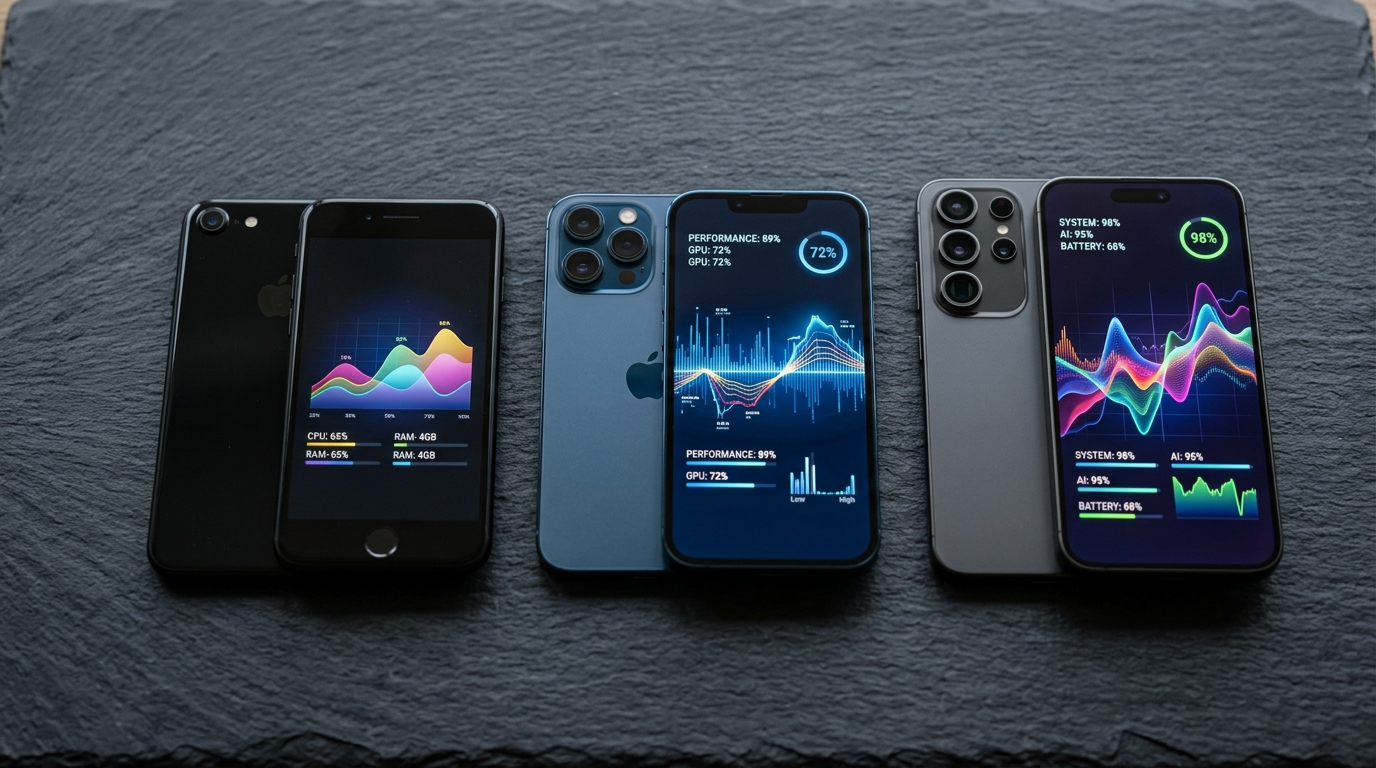
The Appalize 2026 report reveals a stark contrast in ecosystem monetization: Apple's App Store generates 1.7 times the revenue of Google Play, despite handling only one-third of the downloads. This tells us that iOS users are highly willing to pay for premium utility, but their expectations for performance are exceptionally strict. Whether a customer is using a standard iPhone 14 or a five-year-old device, they expect native-level responsiveness. Mega-apps fundamentally struggle here because loading their massive interfaces requires significant processing overhead, whereas single-purpose apps load instantly and respect system resources.
AI implementation requires practical purpose, not just presence
The integration of artificial intelligence into consumer software has fundamentally altered industry economics, but often at the expense of the end user's experience. A recent 2026 Tech Trends analysis by Deloitte Insights notes that leading generative AI tools reached roughly 800 million weekly users—about 10% of the planet's population. The report also highlights a significant financial reality: AI startups scale from $1 million to $30 million in revenue five times faster than traditional SaaS companies did.
However, simply embedding a chatbot into an existing product is not a strategy. As Deloitte's 2026 Global Software Industry Outlook points out, there is a necessary shift happening from merely adding AI features to executing true AI-first engineering. The infrastructure built for old cloud-first strategies simply cannot handle modern AI economics.
My colleague Can Arslan covered this structural shift in his piece, "Mega-Apps vs. Focused Utilities: A Technical Look at the Dynapps Product Philosophy," detailing why specialized architecture is superior. We applied this exact principle when developing Wrapped AI Chat Analysis Recap. Instead of building a generic assistant, we built a highly focused tool that processes WhatsApp chat histories locally to generate structured, entertaining behavioral summaries. It executes one specific task efficiently, keeping the knowledge half-life relevant without burdening the user with unnecessary features.
Communication boundaries require dedicated infrastructure
A common counterargument I hear in the industry is that hardware manufacturers and telecom carriers will eventually render third-party communication utilities obsolete. The theory goes that features like dual-eSIMs or complex, hybrid carrier contracts like Google Fi will solve the need for professional and personal separation.
I completely disagree. While those services are excellent for international data routing, they completely fail at the software interface level. Users do not want to manage multiple carrier contracts; they want software-level isolation for their digital identities. They want to mute an app at 5:00 PM, not manage network settings.

This is precisely why a dedicated second phone number remains a critical utility. Independent professionals, online sellers, and privacy-conscious individuals need a disposable or secondary communication layer that exists entirely within an app environment. Our solution, Second Phone Number DoCall 2nd, was engineered to provide this exact isolation. It delivers reliable VoIP capabilities and SMS routing without requiring the user to alter their primary carrier relationship. By treating the phone number as a software interface rather than a hardware limitation, we give users absolute control over their availability and privacy.
Digital safety succeeds through transparent design
Perhaps the most misunderstood software category today is family tracking. The traditional approach to these applications has been rooted in surveillance—running silently in the background, harvesting constant location pings, and creating an adversarial relationship between parents and teenagers.
In my direct experience designing these tools, opaque tracking ultimately fails. It breeds resentment and encourages users to find technical workarounds, such as disabling location permissions or leaving devices behind. The only way location-based services and monitoring tools succeed long-term is through transparent, mutual consent.
When we approach this category as a company, we prioritize visibility. Our app portfolio's safety tools include software designed around mutual agreement. For example, Mona - Family Tracker App operates on the premise of clear online status monitoring for messaging platforms like WhatsApp and Telegram. It allows families to coordinate and verify digital safety without resorting to invasive GPS logging. As my colleague Naz Ertürk noted in her guide regarding how to choose the right mobile app category for everyday communication needs, selecting the right tool requires matching the software to the actual privacy expectations of your household.
If you are evaluating family software, apply this simple decision framework:
- Does the tool notify all parties when monitoring is active? (Transparency)
- Can the monitored user easily audit what data is being shared? (Control)
- Does the software drain the device battery by constantly pinging background servers? (Efficiency)
Sustainable utility outperforms temporary novelty
The organizations that will thrive in the next decade of mobile software are those that understand their boundaries. A company shouldn't try to be the operating system; it should aim to be the most reliable tool on the user's home screen.
Users are making deliberate choices to declutter their digital lives. They want an app that provides a clean second communication line, an app that helps their family stay safe, and an app that analyzes their data without overstepping its bounds. By focusing on specialized, high-performance software that works reliably across all device generations, developers can provide the exact utility users are searching for—nothing more, and absolutely nothing less.