
Why is your home screen full but your daily problems remain unsolved?
Imagine setting up a recently purchased device. Maybe you just upgraded to an iPhone 14 Pro for your growing independent business, or perhaps you are finally handing down your reliable iPhone 11 to a younger family member. You restore your backup from the cloud, and within minutes, your screen is populated with dozens of familiar icons. You have applications for shopping, social networking, banking, and productivity. Yet, the moment you need to handle a specific, immediate task—like setting up a dedicated business line without switching your carrier, or checking if your teenager made it home safely—you realize your massive digital toolkit is entirely unhelpful. The app bloat is real, but the actual utility is missing.
As a backend developer specializing in cloud-based communication services, I study how data moves between devices and servers. The fundamental issue I see across the industry is that developers frequently try to build monolithic platforms that do everything for everyone. These heavy applications inevitably suffer from feature bloat, complex API dependencies, and sluggish performance. Users do not want massive software suites; they want a specific tool that solves a specific problem reliably.
The scale of this issue is massive. According to Ericsson's market projections, there are over 8.9 billion mobile subscriptions globally as of 2026. Furthermore, the global mobile application market size is estimated to reach $378 billion this year. Despite these staggering numbers, user frustration remains high when it comes to practical, everyday utility. People are actively searching for task-specific solutions that do not overcomplicate their digital lives.
The shift toward task-specific mobile architecture
At our company, Dynapps, we engineer applications based on a principle of isolated utility. Instead of building one massive app, we develop focused tools that handle distinct workloads. A targeted approach allows us to optimize server response times, manage database queries efficiently, and ensure user privacy by only collecting the data necessary for that specific function.
Naz Ertürk explored this methodology thoroughly in a previous post detailing how Dynapps maps product decisions to real mobile needs. As she pointed out, long-term product direction must be shaped by user friction, not just arbitrary feature lists. When evaluating our portfolio, our apps naturally group into three core areas: managing dual communication streams, coordinating family visibility, and analyzing dense text data.
Isolating communication: When one device needs two lives
The boundary between professional and personal communication has completely eroded for many independent contractors, freelancers, and small business owners. If you are running operations from a standard iPhone 14 or slightly older models like the iPhone 13, you likely use the same device to call your clients and your family. Mixing these communication streams leads to missed professional inquiries and unwanted interruptions during personal time.
Historically, solving this meant carrying two physical devices or attempting to port numbers to complex alternative carriers like Google Fi. Both options require significant hardware or network commitments. The technical solution we prefer involves utilizing Voice over Internet Protocol (VoIP) routing directly through the user's existing internet connection.
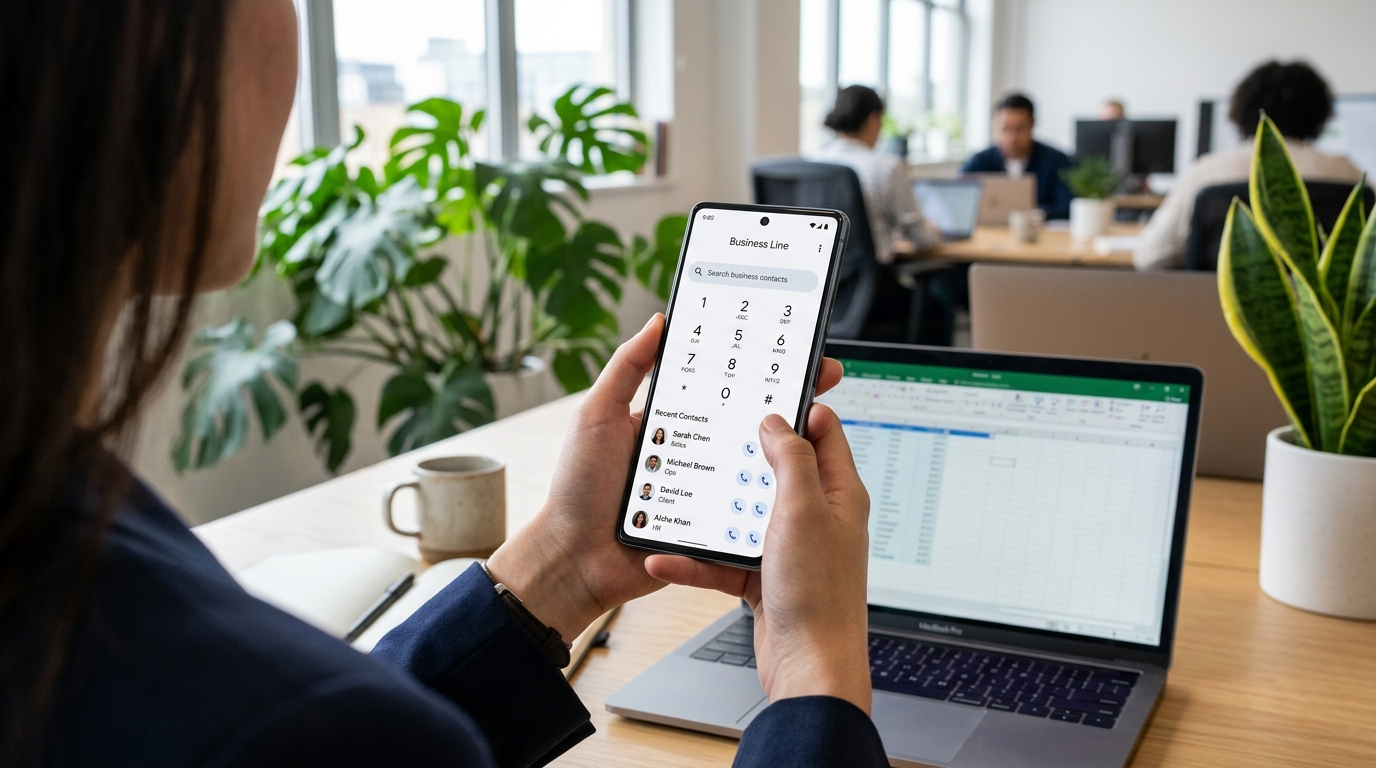
This is the exact infrastructure problem solved by Second Phone Number DoCall 2nd. From a backend perspective, delivering a functional second phone number requires maintaining low-latency SIP (Session Initiation Protocol) trunking and highly reliable push notification services. When a call hits our servers, it must be routed to the specific device in milliseconds, regardless of whether the user is on Wi-Fi or cellular data. By isolating this functionality into a dedicated app, users gain a professional boundary without altering their primary carrier contract. They can issue a dedicated business number, configure separate voicemail, and turn off professional notifications at the end of the day, leaving their personal line completely unaffected.
How do you manage family visibility without compromising trust?
Another major area of friction involves family coordination. Parents and guardians need to know their family members are safe, but traditional location-tracking tools are often heavily intrusive. They drain device batteries through constant GPS polling and can create environments of mistrust.
A more lightweight approach relies on activity status rather than continuous geolocation. By observing when a device is active on major messaging platforms, families can maintain awareness without the heavy footprint of constant geographic surveillance. The engineering challenge here is building a system that reliably polls public status indicators without violating platform terms of service or overloading the device's background processes.
Our portfolio includes Mona - Family Tracker App to address this precise scenario. Mona is designed to monitor "last seen" and online status activity directly for platforms like WhatsApp and Telegram. From an architecture standpoint, this requires a highly concurrent backend capable of processing thousands of lightweight status checks per minute, then pushing that data to the user interface cleanly. It provides parents with the peace of mind that their children are active and safe online, utilizing a task-specific design that avoids the battery drain and privacy concerns associated with heavy GPS alternatives.

Processing communication noise with applied AI
We are generating text data at an unprecedented rate. Years of daily messaging history sit untouched on our devices because manually reviewing thousands of messages is impossible. However, the adoption of localized data processing is changing how we interact with our own histories.
The demand for intelligent data analysis is currently driving significant market changes. Sensor Tower reported 1.7 billion global downloads of GenAI apps in just the first half of 2025. Furthermore, Gartner projects that by the end of 2026, 40% of enterprise applications will feature task-specific AI agents. However, as highlighted in Deloitte’s Tech Trends 2026 study, the rapid adoption of AI requires a careful balance between innovation and security. Users want intelligent summaries of their data, but they do not want to sacrifice their privacy to get them.
To safely provide users with insights into their communication habits, we developed Wrapped AI Chat Analysis Recap. This application solves the problem of unstructured data overload by allowing users to export their WhatsApp chat histories and upload them for analysis. The system parses the raw text logs, structures the data, and utilizes natural language processing to generate entertaining, detailed summaries of the conversation.
Building this required strict attention to data handling protocols. As a developer, the priority when dealing with raw user chat logs is ensuring the parsing happens securely, the memory overhead is managed efficiently, and the data is not retained beyond the immediate generation of the recap. It is a perfect example of a task-specific AI deployment: the app performs one complex analytical job exceptionally well, delivers the result to the user, and respects the boundaries of the data provided.
Building infrastructure for the 2026 mobile ecosystem
Mobile users are becoming increasingly selective about the software they allow on their devices. They evaluate tools based on direct utility, privacy standards, and system performance. As Naz Ertürk emphasized in her guide on how to choose the right mobile app category for everyday communication needs, identifying the actual problem you are trying to solve is the most important step in curating your digital environment.
By focusing our engineering resources on distinct, isolated problems, Dynapps ensures that our infrastructure remains agile and our user experience remains clear. Whether it involves routing secure VoIP packets for a business call, efficiently checking network statuses for family peace of mind, or securely structuring text data for analytical summaries, the goal is always the same: deliver exactly what the user needs, exactly when they need it, without the bloat.