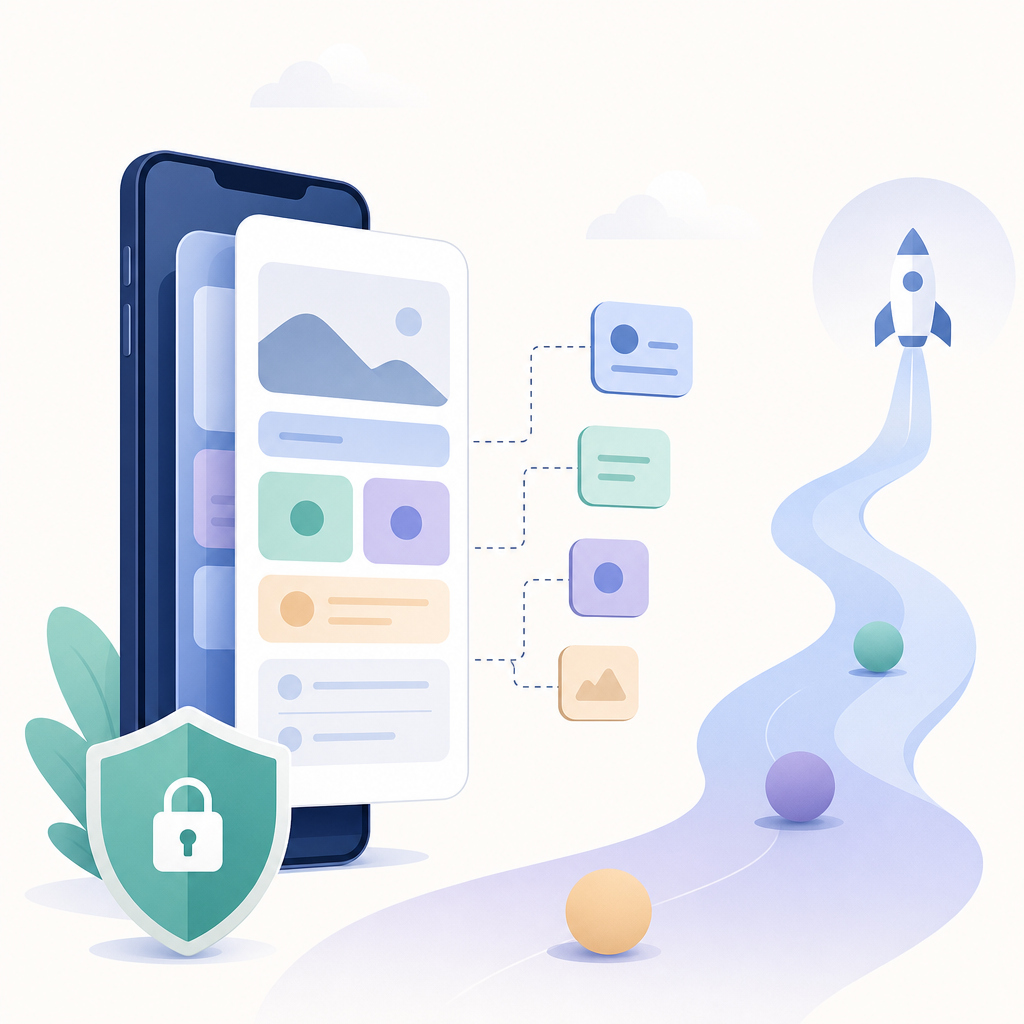
Short answer: A consumer app development company should not start with a feature list; it should start with the moment a person reaches for the phone and decide what must happen before that moment loses urgency. For a utility or lifestyle app, the early call is usually scope: one sharp job, a safe data model, and a release path that can survive real store review.
At Dynapps, the category is practical rather than abstract: apps like DoCall, Mona, and Wrapped AI sit close to daily habits, personal data, notifications, and payment decisions. That changes the work. A good mobile app studio asks what can be built, what should be asked of the user, what consent requires, and what belongs outside version one.
How we checked: For this revision, we checked volatile platform/legal wording, unsupported evidence labels, casing, and whether examples stay within draft. This is editorial review, not an app-store audit.
What does a consumer app development company actually do?
Direct answer: A consumer app development company defines, designs, builds, tests, launches, and improves mobile products for everyday users. The core concept is simple: it turns a recurring consumer problem into an app experience that works on iOS, Android, or both, while respecting store rules, privacy expectations, and commercial constraints.
The word consumer matters. A B2B workflow can assume training, admin setup, and slower adoption. A consumer app gets a few seconds to prove itself. If the first session is confusing, the user is usually gone before support or sales can help.
For a utility app, the product has to do useful work quickly: record a call with consent, summarize a personal moment, create a reminder, format a document, organize a habit, or help someone complete a small job from a phone. Lifestyle apps add taste and emotion, but they still need the same discipline. The app has to answer a user's private question: why this, why now, why trust it?
How are mobile apps built when the idea is still rough?
Direct answer: How mobile apps are built depends less on the idea pitch and more on the first usable job. The safest early process is to reduce the idea into a user moment, a permission boundary, a platform route, and a version-one promise that can be tested without pretending the whole product exists.
Take a realistic brief: a founder wants an app that helps people capture and organize phone-call details. The first version could try contact sync, call notes, recordings, AI summaries, reminders, billing, team sharing, and search. That is too much. The better first decision is to separate the user's urgent job from the team's wish list.
- User moment: What just happened that makes the person open the app right now?
- Main action: What is the smallest action that creates value in the first session?
- Permission boundary: Does the app need contacts, microphone access, call data, location, payment, or account access?
- Trust signal: What must the app explain before asking for sensitive access?
- Failure case: What happens if the user refuses a permission, has no network, or changes their mind?
This is where a mobile app studio earns its keep. It should make the product smaller without making it weaker. That is not a compromise; it is how a first release becomes buildable.
What should a mobile app studio validate before design starts?
Direct answer: A mobile app studio should validate the job, permissions, data sensitivity, platform constraints, and monetization path before it polishes screens. Visual design matters, but beautiful screens cannot rescue a product that asks for the wrong data, prices too early, or depends on a platform behavior that is not allowed.
Method note: The table below is a planning checklist, not a market benchmark; early consumer behavior cannot be proven from a workshop.
| Planning question | Why it matters | Decision it changes |
|---|---|---|
| Can the user get value in one short session? | Consumer apps often lose attention before setup is complete. | Onboarding length, first action, empty states. |
| Which permission is truly required? | Contacts, microphone, location, and account access create trust costs. | Permission timing and fallback flows. |
| What personal data is stored? | Private utility apps need clear retention, export, and deletion choices. | Backend design, account model, support policy. |
| Is the app used daily or occasionally? | A daily app can ask for habit formation; an occasional app must be useful after long gaps. | Notifications, reminders, home screen shortcuts. |
| What is the paid moment? | A paywall before value can feel hostile; a paywall after heavy processing can be expensive. | Trial design, feature gating, billing integration. |
The answer is rarely one perfect scope. More often, it is a defensible trade-off. If version one delays a clever AI feature so the team can finish consent, account recovery, and export properly, that may be the right call.
What does a practical app development process look like?
Practical answer: A practical app development process moves from product brief to prototype, from prototype to build, and from build to measured release. Each stage should reduce a different risk: user confusion, technical feasibility, store rejection, privacy failure, or weak retention.
- Write the one-job brief. Define the user, the trigger moment, the main action, and the result the app must deliver.
- Map the first session. Sketch the path from install to first useful outcome, including permission prompts and refusal states.
- Choose the platform route. Decide iOS, Android, or both, then pick native, cross-platform, or phased development based on risk and budget.
- Prototype the hard screen. Start with the screen where trust, value, or payment is most likely to break.
- Build the data model early. Sensitive apps need storage, deletion, export, and access control designed before interface polish.
- Test on real devices. Use device testing, TestFlight, internal Google Play testing, and store-prep checks before public release.
- Instrument only what is needed. Track product events that answer launch questions without collecting private content by default.
Where do privacy, consent, and platform limits shape the product?
Direct answer: Privacy and consent shape the product before engineering starts, especially for recording, tracking, messaging, identity, and personal-data features. A responsible consumer app studio treats consent, lawful use, platform security, and user control as product requirements, not legal text added at the end.
For tracker-like features, the clean rule is narrow: only track an account, device, or person that has agreed, and explain what data is collected, how long it is stored, and how to stop it. A product should not imply it can read encrypted message content, secretly monitor another person, or bypass iOS or Android security controls. It cannot do those things honestly.
Call recording has an extra constraint. Consent rules vary by jurisdiction, and app stores also care how recording is presented. A responsible app makes consent visible in the flow, does not coach users to record secretly, and treats deletion and export as part of the feature.
Claim: The fastest consumer app is not always the one with the fewest screens; it is the one with the fewest unresolved trust decisions. Example: A call-notes app with clear consent, storage, export, and refusal flows is less risky than a broader app promising recording, summaries, group monitoring, and billing on day one. Limit: This does not prove market demand or retention. Action: Resolve sensitive permissions before adding adjacent features.
How should a consumer app studio decide what to ship first?
Direct answer: A consumer app studio should ship the smallest version that proves the core user job and the trust model at the same time. If the app cannot create value without risky permissions, unclear data handling, or a confusing paywall, it is not ready just because the screens look finished.
Version one should feel narrow from the inside and complete from the outside. That means fewer features, but not half-built features. A scanner app should export cleanly. A call utility should explain consent. A lifestyle app should remember the user's choices that matter. A paid app should make the paid moment understandable before the charge.
There is a real limitation here: a smaller release can disappoint stakeholders who expected a big app. It may also push some ambitious features into later cycles. The trade-off is worth making when the alternative is a wide product with no clean first session, no reliable support path, and no clear way to learn after launch.
What changes after the app is live?
After launch: The work shifts from building assumptions to reading behavior. Store reviews, crash reports, support messages, billing events, and feature usage show where the app is helping people and where the product promise is too vague.
This is the point where discipline matters again. Teams can overreact to the loudest review or chase features that look exciting in a roadmap meeting. The better rhythm is slower: fix broken paths first, improve confusing flows second, and add new capability only when the existing app proves where users are getting stuck.
A consumer app development company should also keep the store listing and product experience aligned. If the listing promises simple call organization, the first session should not feel like an enterprise CRM. If the app sells a personal AI summary, the interface should make data use and user control plain. Trust is built in small, repeated matches between promise and behavior.
Frequently asked questions
What is a consumer app development company?
A consumer app development company builds mobile apps for individual users rather than internal teams or enterprise buyers. It usually handles product strategy, UX design, native or cross-platform engineering, testing, store release, analytics setup, and post-launch iteration.
What is the difference between a mobile app studio and a standard agency?
A mobile app studio is usually more product-focused. It should help decide what the app should be, not only produce screens and code from a fixed brief. A standard agency may still do excellent work, but the distinction matters when the idea needs product judgment before build.
Can a consumer app studio build AI features into an app?
Yes, but AI should serve a specific user job, such as summarizing, sorting, drafting, or recognizing patterns. The app still needs clear consent, data controls, fallback behavior, and honest wording about what the AI can and cannot do.
How much of the app development process should happen before coding?
Enough to settle the main job, permission model, first-session flow, platform route, and release scope. Coding too late creates waste, but coding before those decisions are clear often creates a polished app that solves the wrong problem.
What should I prepare before talking to a consumer app studio?
Bring the user problem, the first action the app should support, the data the app may need, the platforms you care about, and any hard constraints around budget, launch date, privacy, or monetization. A rough brief is fine if the core user moment is clear.